
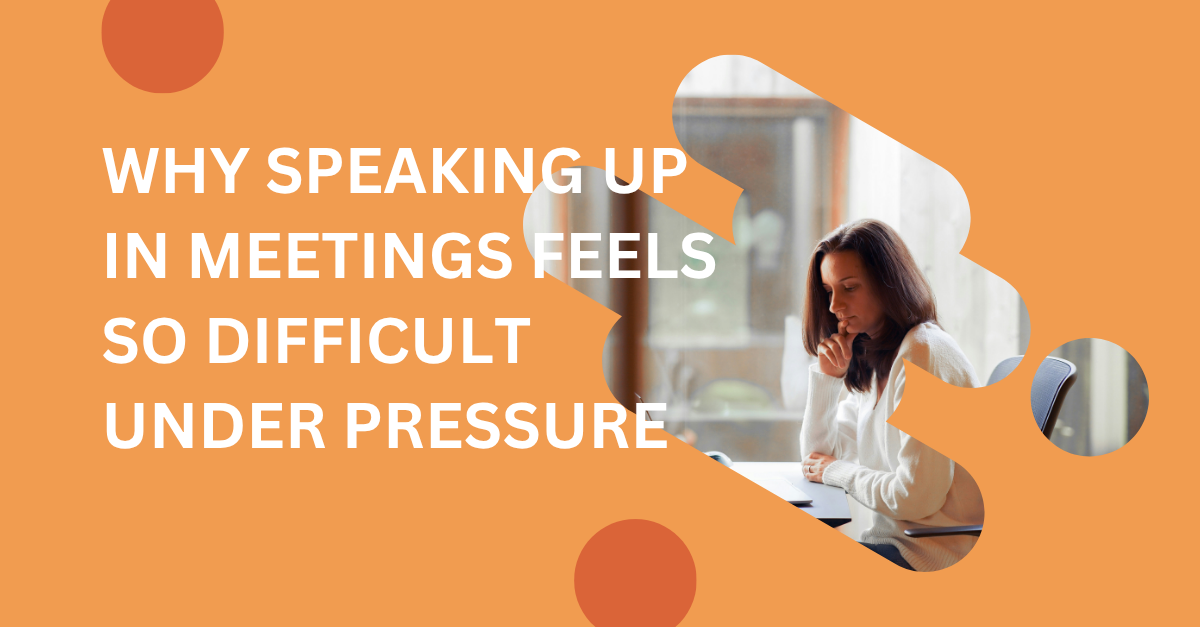
If you’ve ever struggled with speaking up in meetings at work, especially in high-pressure environments, you’re far from alone.
You had something to say…and didn’t say it and you’ve probably had this experience more than once.
You’re in a meeting. You’ve prepared, you understand the topic, and as the conversation unfolds you can feel a point forming quite clearly. It’s relevant, it’s considered, and you can back it up if you need to.
It’s in your head. And yet…you don’t say it.
The moment moves on and someone else speaks. Then the conversation shifts slightly, and continues without you. By the time you come back to your point, it feels harder to speak. You tell yourself you’ll find another moment. Most likely, you won’t.
Afterwards, it’s frustratingly clear what you “should” have said. You play it back in your head, almost word for word. You might even say it out loud to yourself later, noticing how obvious it sounds in hindsight.
Which then leads to the lingering question:
“If I knew what to say…why didn’t I say it?”
Why capable professionals stay quiet in meetings
This is usually the point where people criticise themselves. You might tell yourself you should be more confident and you need to speak up more. That, given your experience and capability, you should be better at this by now.
And none of those thoughts are particularly helpful. Because what’s happening in that moment is something much more practical, and much more human, not a lack of knowledge or even a lack of capability.
Your body is doing exactly what it’s designed to do.
When a moment carries even a small amount of pressure or visibility, your system starts to assess risk. Not in a dramatic way and not in a way that’s obvious to anyone else in the room. It’s subtle. Quiet…and often happening just below your own awareness.
You question whether your comment will land well. Whether people will “get it” or whether you’ve missed something. After all, everyone else seems to get it and you seem to have a different opinion.
Research into psychological safety by Amy Edmondson at Harvard Business School has consistently shown that people are less likely to contribute ideas or questions when there’s even a small perception of interpersonal risk.
As soon as there’s even a hint of uncertainty, your system looks for the safest available option. And often, that means staying quiet in a meeting. It reduces exposure and avoids potential judgment. It keeps things predictable.
So, from your system’s perspective, it makes complete sense.
The nervous system’s role in workplace confidence
It also explains why so much of the advice around “just be more confident” doesn’t really land in the moments where you need it most.
Because when pressure increases, you don’t suddenly gain access to more thinking or better reasoning. In reality, the opposite happens and you tend to fall back on familiar patterns. Patterns that have, at some point, helped you stay safe.
So trying to override that response with more thinking or more pressure rarely works.
A more useful shift is to change the question slightly.
Instead of asking:
“Why am I not confident enough to speak?”
It becomes:
“How do I make it easier to contribute, even when pressure makes me hesitate?”
That’s a very different starting point.
It moves you away from fixing yourself, and towards working with what’s already happening.
Why “just be more confident” rarely works
There’s usually a very specific moment where this plays out.
You have the thought. The point is there. And then, almost immediately, there’s a pause.
That pause matters.
It’s often small enough to miss, though it’s the moment where things can go in one of two directions. You either stay with the thought and bring it into the conversation or you move into hesitation, and the moment passes.
Most people wait at that point.
They wait until the idea feels fully formed and they wait until they can phrase it perfectly. They wait for a clear opening in the conversation, which may not happen.
And the longer you wait, the harder it becomes to speak.
Not because the initial idea has changed so much as your system has had more time to build a case for staying quiet.
So rather than trying to eliminate hesitation altogether, which isn’t particularly realistic, it can be more helpful to work with timing.
A simple way to speak up earlier in meetings
A simple place to start is this:
Say something slightly earlier than you normally would.
Instead of waiting until it’s fully polished or you’re completely certain. Just a little earlier in your thinking process.
That might look like:
- Starting with a partial thought rather than a fully formed conclusion.
- Asking a question that brings your perspective into the room.
- Offering the first sentence of your point, rather than waiting until you’ve mentally rehearsed the whole thing.
Why is this helpful?
Firstly, it interrupts the pattern of hesitation before it fully takes hold. It keeps you in the conversation, which makes it easier to continue contributing. And it reduces the pressure to get everything exactly right before you speak.
It’s also something you can practise. In small, real moments instead of a big, dramatic way. So you still feel reasonably safe.
One meeting. One contribution. One sentence earlier than usual.
That’s enough.
Building self-trust under pressure
Over time, this builds something much more useful than confidence in the way it’s often described.
It builds self-trust and it nudges you against the edge of your comfort zone.
The experience of noticing a thought, acting on it, and seeing that you can stay in the conversation without everything needing to be perfect first.
You’ve got the knowledge and you’ve already done the thinking. This is about being able to use it in the moments that matter.
So as you head into your next meeting, notice the moment where you begin to hold back.
And see what happens if you speak slightly earlier than you normally would.
Not perfectly or fully formed.
Just earlier.
That’s what makes the difference.